There's No Excuse to Be Disorganized Anymore
Getting organized used to cost an ops hire. Now it costs a prompt, so disorganization is a choice, not a constraint.
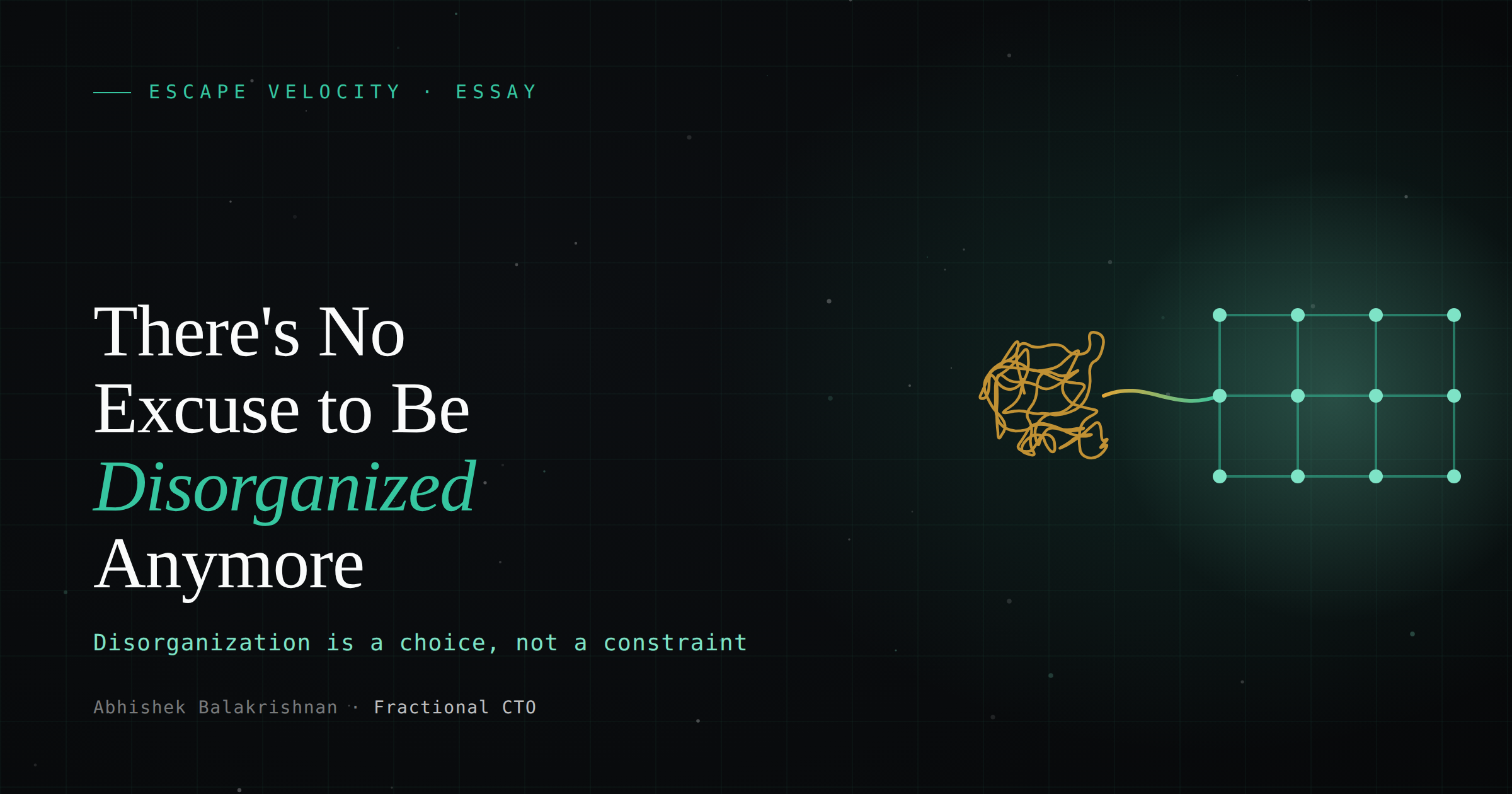
There’s no excuse to be disorganized anymore, but even with AI, building a startup is still a chaotic endeavor. Understandably, there are so many things to juggle, and most of the time founders are incredibly passionate about the core science of their domain, or solving the problem that their market needs. Rarely do founders think, or even want to think, about operations, and it’s a pity that they either lose much of their time to admin and ops, or forget about it while selling and end up endlessly firefighting while trying to realize the beautiful vision they’ve sold to their customers.
Some of that chaos is real. Every company has essential complexity, the genuinely hard core of the problem you are solving, and that is where your passion belongs. But most of what buries founders is accidental complexity: the self-inflicted overhead that accretes around the real work because no one had the time to tame it. That used to cost an operations hire and hours no founder has. Now it costs a prompt. Disorganization is no longer a constraint. It is a choice.
The truth of the matter is that the moment you have more than one person, you get into a coordination problem. Without strong culture, strong values, and engineering discipline, you risk never getting close to the velocity you need. This is not process for its own sake. It is what protects your speed. I’ve spent years building companies and organizations into well-oiled machines, and there’s a reason this matters. There’s a reason you have to harp on culture every single day. There’s a reason you have to be a stickler for process, even when it seems there should be fewer barriers to innovation and delivery. AI makes that so much easier.
This is what a responsible CTO or COO does, full-time or fractional. The job was never just architecture. It is recognizing that technology and operations sit at the heart of the people doing the work and the product you deliver. A few months ago I gave a keynote on exactly this at the Energy Thought Summit in San Antonio: how AI, implemented responsibly, helps us reclaim our attention, focus on what matters, and navigate complexity instead of drowning in it.
If you’re running an organization, audit yourself against these three. AI can now stand up each in a fraction of the time it used to take. The catch is that your attention still has to go into the quality of each system and the purpose behind it.
- A charter that captures the values you work by, that everyone actually abides by. AI can draft it, pressure-test it, and keep it living instead of dead.
- A fully enabled CI/CD with the right checks and balances, so when you need to put out a fire for a customer, nothing stands between you and the hotfix, and the fix does not spawn three new problems. AI can write the tests and review the changes.
- A single source of truth, the company’s memory: proposals, contracts, playbooks, policies, literally anything. Searchable, drafted from your own templates, so a new hire ramps in hours instead of months.
Let your mission and your systems move as one. Neither should burden the other, and neither should lag behind.

This article was drafted with Wispr Flow.