<?xml version="1.0" encoding="utf-8"?><feed xmlns="http://www.w3.org/2005/Atom" ><generator uri="https://jekyllrb.com/" version="3.10.0">Jekyll</generator><link href="https://solutions.theanbgroup.com/feed.xml" rel="self" type="application/atom+xml" /><link href="https://solutions.theanbgroup.com/" rel="alternate" type="text/html" /><updated>2026-07-28T04:37:07+00:00</updated><id>https://solutions.theanbgroup.com/feed.xml</id><title type="html">ANB Solutions</title><subtitle>Writing from ANB Solutions on technology leadership, turning services into products, and putting AI and automation to work at enterprise scale.</subtitle><author><name>Abhishek Balakrishnan</name></author><entry><title type="html">There’s No Excuse to Be Disorganized Anymore</title><link href="https://solutions.theanbgroup.com/blog/no-excuse-to-be-disorganized/" rel="alternate" type="text/html" title="There’s No Excuse to Be Disorganized Anymore" /><published>2026-07-27T00:00:00+00:00</published><updated>2026-07-27T00:00:00+00:00</updated><id>https://solutions.theanbgroup.com/blog/no-excuse-to-be-disorganized</id><content type="html" xml:base="https://solutions.theanbgroup.com/blog/no-excuse-to-be-disorganized/"><![CDATA[<p><img src="/assets/images/be-organized-cover.png" alt="There's No Excuse to Be Disorganized Anymore" /></p>

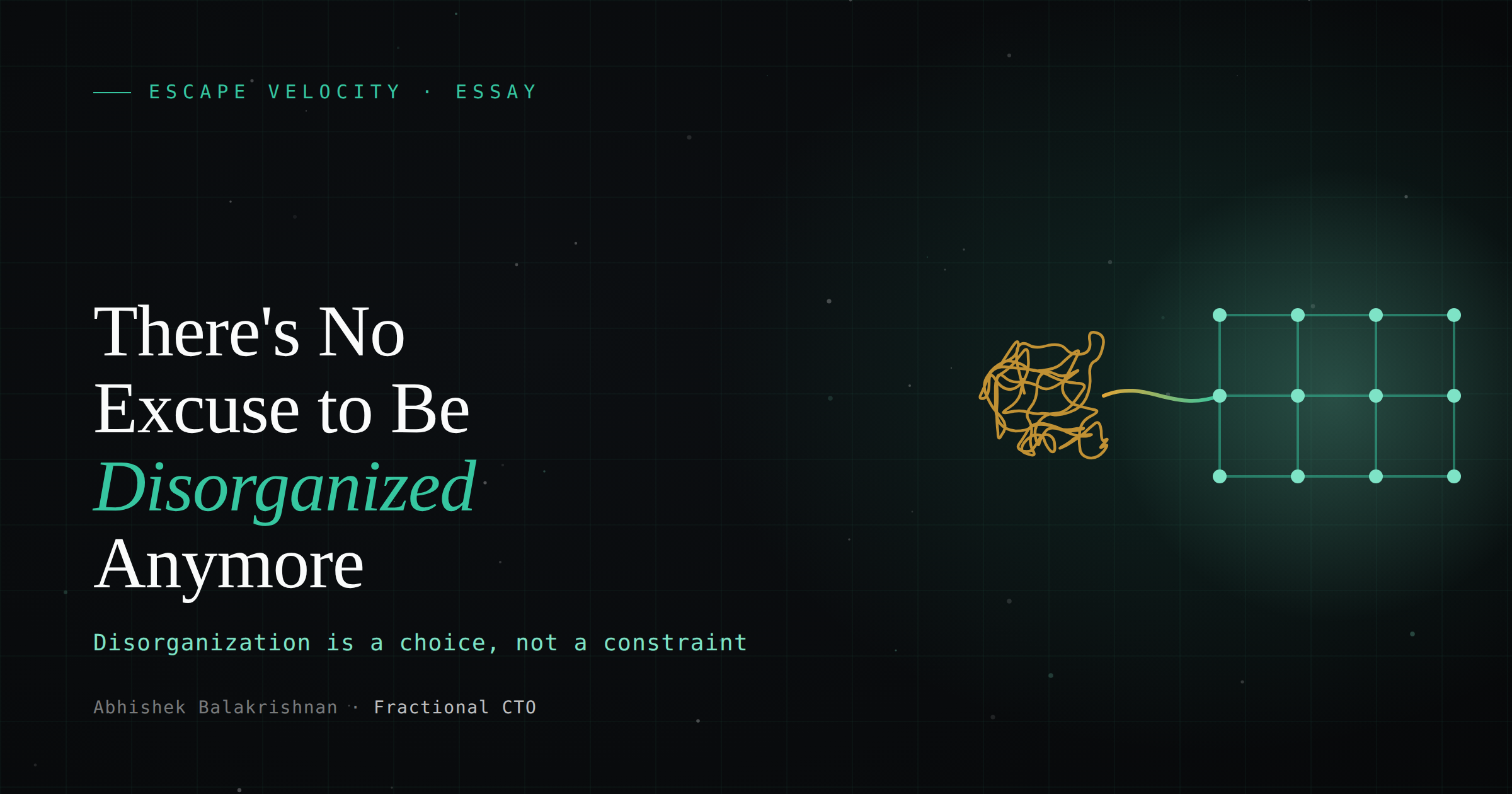
<p>There’s no excuse to be disorganized anymore, but even with AI, building a startup is still a chaotic endeavor. Understandably, there are so many things to juggle, and most of the time founders are incredibly passionate about the core science of their domain, or solving the problem that their market needs. Rarely do founders think, or even want to think, about operations, and it’s a pity that they either lose much of their time to admin and ops, or forget about it while selling and end up endlessly firefighting while trying to realize the beautiful vision they’ve sold to their customers.</p>

<p>Some of that chaos is real. Every company has essential complexity, the genuinely hard core of the problem you are solving, and that is where your passion belongs. But most of what buries founders is accidental complexity: the self-inflicted overhead that accretes around the real work because no one had the time to tame it. That used to cost an operations hire and hours no founder has. Now it costs a prompt. Disorganization is no longer a constraint. It is a choice.</p>

<p>The truth of the matter is that the moment you have more than two people, you get into a coordination problem. Without strong culture, strong values, and engineering discipline, you risk never getting close to the velocity you need. This is not process for its own sake. It is what protects your speed. I’ve spent years building companies and organizations into well-oiled machines, and there’s a reason this matters. There’s a reason you have to harp on culture every single day. There’s a reason you have to be a stickler for process, even when it seems there should be fewer barriers to innovation and delivery. AI makes that so much easier.</p>

<p>This is what a responsible CTO or COO does, full-time or fractional. The job was never just architecture. It is recognizing that technology and operations sit at the heart of the people doing the work and the product you deliver. A few months ago I gave a keynote on exactly this at the Energy Thought Summit in San Antonio: how AI, implemented responsibly, helps us reclaim our attention, focus on what matters, and navigate complexity instead of drowning in it.</p>

<p>If you’re running an organization, audit yourself against these three. AI can now stand up each in a fraction of the time it used to take. The catch is that your attention still has to go into the quality of each system and the purpose behind it.</p>

<ol>
  <li>A charter that captures the values you work by, that everyone actually abides by. AI can draft it, pressure-test it, and keep it living instead of dead.</li>
  <li>A fully enabled CI/CD with the right checks and balances, so when you need to put out a fire for a customer, nothing stands between you and the hotfix, and the fix does not spawn three new problems. AI can write the tests and review the changes.</li>
  <li>A single source of truth, the company’s memory: proposals, contracts, playbooks, and the lessons you have already paid for. Searchable, drafted from your own templates, so a new hire ramps in hours instead of months.</li>
</ol>

<p>Let your mission and your systems move as one. Neither should burden the other, and neither should lag behind.</p>

<p><img src="/assets/images/be-organized-lockstep.png" alt="Mission and systems rising in lockstep to a shared point" /></p>

<p><em>This article was drafted with Wispr Flow.</em></p>]]></content><author><name>Abhishek Balakrishnan</name></author><category term="Mindset" /><category term="Products" /><summary type="html"><![CDATA[Building a startup is still chaotic, but most of that chaos is self-inflicted. AI makes operational discipline cheap, so disorganization is now a choice.]]></summary><media:thumbnail xmlns:media="http://search.yahoo.com/mrss/" url="https://solutions.theanbgroup.com/assets/images/be-organized-cover.png" /><media:content medium="image" url="https://solutions.theanbgroup.com/assets/images/be-organized-cover.png" xmlns:media="http://search.yahoo.com/mrss/" /></entry><entry><title type="html">Your Developer Is Not Your CTO: Why Startups Need High-Quality Advisors</title><link href="https://solutions.theanbgroup.com/blog/your-developer-is-not-your-cto/" rel="alternate" type="text/html" title="Your Developer Is Not Your CTO: Why Startups Need High-Quality Advisors" /><published>2026-07-20T00:00:00+00:00</published><updated>2026-07-20T00:00:00+00:00</updated><id>https://solutions.theanbgroup.com/blog/your-developer-is-not-your-cto</id><content type="html" xml:base="https://solutions.theanbgroup.com/blog/your-developer-is-not-your-cto/"><![CDATA[<p><img src="/assets/images/dev-not-cto-cover.png" alt="Your Developer Is Not Your CTO" /></p>

<p>Lately I’ve been advising a few startups on their technology and operations. What I keep finding is that, even in the age of AI, business owners are weighed down by options. They struggle to stand up a lean stack or an agile process while protecting their core revenue priorities.</p>

<p>It shows up at every level. At its most basic, in the past few weeks, I have seen a founder trust a developer through months of delays, only to find the code was barely being checked in, if at all. Nothing consistent, nothing another engineer could pick up tomorrow. That alone crippled a launch and forced a painful scramble to meet new dates. More serious founders are beyond this, but a similar gap still catches them: no one above the developer is asking whether today’s shortcuts survive next year.</p>

<p>Hiring developers or buying software vendors without a technology strategy leads to waste, rework, and milestones that keep slipping. For most of these businesses, a full-time CTO makes no sense. This is exactly where a fractional or short-term CTO advisor becomes paramount.</p>

<p>You are not just looking for someone who can wield AI tools and ship you an MVP. You need someone thinking above the buttons, asking the hard questions about scale, not for tomorrow but for next year and five years out. They give you direction on the decisions that compound:</p>

<ul>
  <li>whether to instrument product analytics now, and how deeply, so a year from now you can actually answer if you are moving in the right direction</li>
  <li>how you stay compliant on security and privacy, with the groundwork done before your first enterprise buyer’s security team asks, not after it stalls the deal</li>
  <li>how you harmonize your stack, including the tooling for automated code delivery, so shipping is routine instead of a manual, nerve-racking event</li>
  <li>where to automate, internally and externally alike, not one or the other, and where each tool or process adds friction for your team or slows your product’s path to customers</li>
</ul>

<p>Without a thinker, someone challenging you and forcing you to look ahead, you stay stuck scrambling for the next deadline and never lift your head up. That matters more than ever right now, when every few months another layer of businesses gets automated away. If all you have is a worker bee building against APIs, what you get is rework on top of rework: hyperscalers wipe out entire layers of APIs overnight, and everything built against them has to be torn up and rebuilt. Not being able to anticipate what work should happen, and when, is a real disadvantage.</p>

<p>If all you have is builders and no one asking the five-year question, that is the first gap to close. Where do you need to be nudged on something your developers are not thinking about?</p>

<p><em>This article was drafted with Wispr Flow.</em></p>]]></content><author><name>Abhishek Balakrishnan</name></author><category term="Mindset" /><category term="Products" /><summary type="html"><![CDATA[Hiring a developer without a technology strategy leads to rework and slipping milestones. A fractional CTO advisor is the thinker who asks the five-year questions.]]></summary><media:thumbnail xmlns:media="http://search.yahoo.com/mrss/" url="https://solutions.theanbgroup.com/assets/images/dev-not-cto-cover.png" /><media:content medium="image" url="https://solutions.theanbgroup.com/assets/images/dev-not-cto-cover.png" xmlns:media="http://search.yahoo.com/mrss/" /></entry><entry><title type="html">Voice to Text… But What’s Next?</title><link href="https://solutions.theanbgroup.com/blog/voice-to-text-whats-next/" rel="alternate" type="text/html" title="Voice to Text… But What’s Next?" /><published>2026-07-14T00:00:00+00:00</published><updated>2026-07-14T00:00:00+00:00</updated><id>https://solutions.theanbgroup.com/blog/voice-to-text-whats-next</id><content type="html" xml:base="https://solutions.theanbgroup.com/blog/voice-to-text-whats-next/"><![CDATA[<p><img src="/assets/images/voice-cover.png" alt="Voice to Text… But What's Next?" /></p>

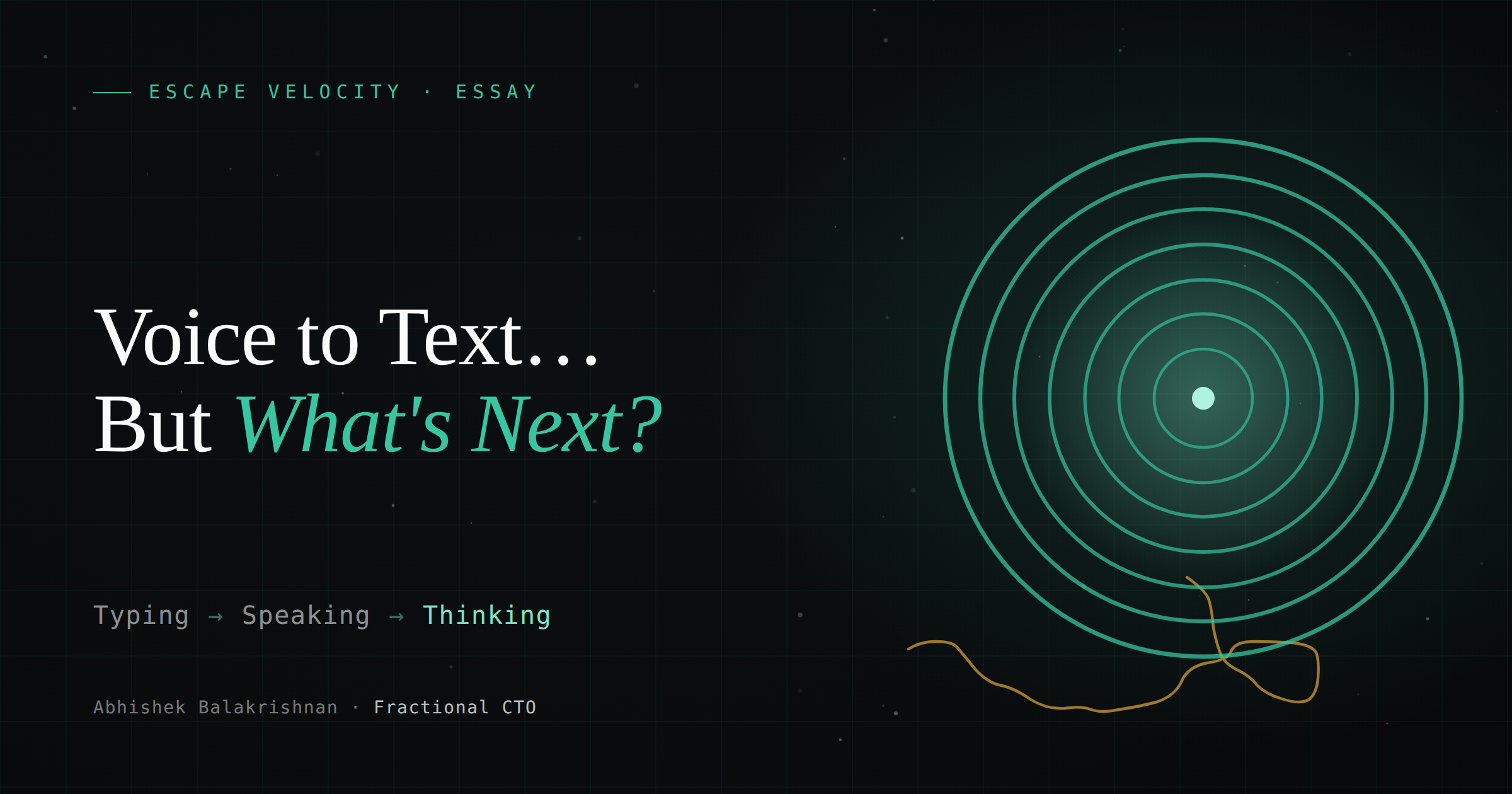
<p>WisprFlow, GPT-Live, and similar voice-to-text interfaces have changed the game for day-to-day communication. Most impactful is the experience of working with LLMs themselves: dictating instructions to your AI agents at a speed that was not possible before. For most people, speech can achieve higher WPM (words per minute) than typing.</p>

<p>But voice is still a physical interface. It depends on your environment, your body, and your ability to speak freely. A sleeping baby in your arms, a public sidewalk, bags in your hands, a grocery cart in front of you: there are plenty of situations where you cannot freely speak or type.</p>

<p>Constraints are healthy. Not every quiet moment needs to become another opportunity for productivity. Unfortunately, innovation culture rarely leaves constraints alone. Once typing is too slow and speaking is sometimes impossible, the next interface is the mind itself.</p>

<p>Elon Musk already planted the seeds for this next interface shift with Neuralink, years before the current text and voice AI revolution. On one hand, it is exciting to think what the upper limit on our communication looks like, where instructions can be dictated at the speed of your thoughts. At the same time, it is deeply concerning how this technology will be exploited.</p>

<p>To understand why that is so risky, it helps to remember that for all of human history, our communication discipline was built around external media (writing and speech), because these are the only media we have been able to observe and refine. Even then, speech is littered with stuttering and repetition. Today, this seems to be getting worse: 1) people have largely stopped writing by hand and from memory, 2) sophisticated language is hardly celebrated, and 3) there are infinite band-aids for poor communication ability. For example, WisprFlow attempts to polish the mess of stream-of-consciousness speech.</p>

<p>If speech is already messy, thought is even less edited. How many of you have any grip on your thought stream? If a brain-interface could suddenly transcribe Thought-to-Text, the output would be chaotic. Two decades ago, JK Rowling teased this as magic through Occlumency and Legilimency. If the technology to transcribe our thoughts is inevitable, it is imperative for us to train our attention as seriously as we train our language and speech: one, for better communication; but two, for our own safety.</p>

<p>The future will not only reward people who can speak well; it may reward people who can observe and regulate their own minds. In other words, if you do not have a meditation practice, you better start now.</p>

<p><img src="/assets/images/voice-meditation.png" alt="A meditating figure held within a zen ensō" /></p>

<p><em>Disclaimer: this post was first drafted with WisprFlow</em> 🙂</p>]]></content><author><name>Abhishek Balakrishnan</name></author><category term="AI" /><category term="Mindset" /><summary type="html"><![CDATA[WisprFlow is revolutionizing productivity and communication efficiency. But given the endless human urge to optimize against barriers, what's next is a bit troubling.]]></summary><media:thumbnail xmlns:media="http://search.yahoo.com/mrss/" url="https://solutions.theanbgroup.com/assets/images/voice-cover.png" /><media:content medium="image" url="https://solutions.theanbgroup.com/assets/images/voice-cover.png" xmlns:media="http://search.yahoo.com/mrss/" /></entry><entry><title type="html">The AI Equation for Small Business</title><link href="https://solutions.theanbgroup.com/blog/the-ai-equation-for-small-business/" rel="alternate" type="text/html" title="The AI Equation for Small Business" /><published>2026-07-07T00:00:00+00:00</published><updated>2026-07-07T00:00:00+00:00</updated><id>https://solutions.theanbgroup.com/blog/the-ai-equation-for-small-business</id><content type="html" xml:base="https://solutions.theanbgroup.com/blog/the-ai-equation-for-small-business/"><![CDATA[<p>The oldest rule in management is that what gets measured improves. Every owner-operator knows it. Few of them actually run their business that way.</p>

<p>They don’t, because measurement was expensive. It took analysts, software budgets, clean data, and hours that don’t exist when you’re the one unlocking the door in the morning. Big companies bought measurement by the department. Small businesses ran on instinct and a spreadsheet, and most still do.</p>

<p>AI changed the math. The marginal cost of analyzing the information you already produce has collapsed, cheap enough that measurement becomes a weekly habit instead of an annual project. Some businesses have already noticed.</p>

<p>It comes down to a simple equation: <strong>measure more, learn faster, decide better.</strong> AI lets you measure things you couldn’t before. It shortens the time between the work happening and you understanding it. And the payoff only lands when that understanding changes a decision. Miss that last step and all you’ve bought is expensive dashboards.</p>

<h2 id="what-changed">What changed</h2>

<p>Two things. First, depth. AI can reach further into your operation than a spreadsheet ever let you: raw material costs, sourcing times, lead times, the second and third-order patterns that were always buried too deep in the stack to dig out by hand. The burden of producing clean, organized data is lifted, so you can ask a hard question on a Tuesday and have an answer, and a deeper discussion, by the afternoon.</p>

<p>Second, and bigger, is what counts as a number now. Forget spreadsheets and paper documents. Video and audio became measurable. For coaching businesses (sports, music, tutoring), the raw material of the craft was never data before. A golf swing, a violin scale, a student working through a problem: you could watch it, but capturing it at scale was out of reach. Now every lesson can produce a record: what was covered, what improved, what to drill next. Technique gets flagged from footage. Progress gets tracked per student, automatically, instead of living in the coach’s memory. This is a co-pilot for the coach, and curated video breakdowns are a premium product parents and students will pay for, built from footage you were already capturing on a phone.</p>

<p><img src="/assets/images/coaching-motion.png" alt="Pose-tracking overlay on a running athlete" />
<em>Video turns the craft into data: every joint, every rep, now measurable.</em></p>

<h2 id="where-i-think-this-goes">Where I think this goes</h2>

<p><img src="/assets/images/restaurant-margin.png" alt="Overhead plate with a per-dish margin gauge" />
<em>Which dishes actually earn their place, measured by the margin on each.</em></p>

<p><strong>A restaurant.</strong> Of forty menu items, which three slipped underwater when ingredient costs moved? Where the real waste is coming from. Which supplier increase is worth a phone call, and which dish to push this week because of it.</p>

<p><strong>A cleaning, pool, or landscaping business.</strong> This one is really about customer service. After every visit, the customer gets an instant report: what was done, who did it, photos as proof. Issues the crew spotted get flagged before anyone has to ask. Honestly, most businesses never did any of this. It was too much work for a busy crew, so the follow-through simply never happened, even though skipping it is bad customer service. Now it writes itself.</p>

<p><strong>Personalized consulting or coaching.</strong> This is where aural and spatial data earns its keep. The cadence and hesitation in a client’s voice, the posture and movement a camera catches, the through-lines across a dozen sessions. Read together, they let you tailor each engagement to the individual in front of you rather than the average client in your head.</p>

<p>Whatever the shape of the operation, the loop is the same. Watch what sells, watch how customers behave, decide, and measure again. When you run lean, that loop does the work a hire used to.</p>

<h2 id="one-honest-limit">One honest limit</h2>

<p>AI does not rescue a business that measures nothing, and it cannot tell you which outcomes matter. You still choose the question, sanity-check the signal, and act on the answer. The tool got cheap. The judgment is still yours.</p>

<h2 id="start-with-one-number">Start with one number</h2>

<p>Skip a grand AI strategy. Pick one question you answer by instinct today, that comes up at least monthly, and that would change a real decision about money, time, or customers. A few that qualify for almost anyone:</p>

<ul>
  <li>Which work actually makes money?</li>
  <li>Where are we losing time?</li>
  <li>Which customers are about to leave?</li>
</ul>

<p>Put AI on one of them this week. When the answer changes what you do, pick the next one.</p>

<p>Measure more, learn faster, decide better. For the first time, a small business can afford to run that loop every week.</p>

<p>Where have you seen a small business use AI to measure something that used to be invisible? I’d genuinely like to know. And if that business is yours and you want a hand putting it to work, my door is open.</p>

<p>— Abhishek</p>]]></content><author><name>Abhishek Balakrishnan</name></author><category term="AI" /><category term="Mindset" /><summary type="html"><![CDATA[The oldest rule in management is 'what gets measured improves.' Small businesses could never afford the measuring. AI changed the math. Here's the equation.]]></summary></entry><entry><title type="html">Agent-First Software: Three Table-Stakes Principles for AI-First Products</title><link href="https://solutions.theanbgroup.com/blog/agent-first-software/" rel="alternate" type="text/html" title="Agent-First Software: Three Table-Stakes Principles for AI-First Products" /><published>2026-06-30T00:00:00+00:00</published><updated>2026-06-30T00:00:00+00:00</updated><id>https://solutions.theanbgroup.com/blog/agent-first-software</id><content type="html" xml:base="https://solutions.theanbgroup.com/blog/agent-first-software/"><![CDATA[<p><em>Agent-first is the new mobile-first. The clearest sign a product is ready for it is almost embarrassingly small: can you get your data out in a single click, cleanly and completely, no matter whether you are a human or you are an agent?</em></p>

<h2 id="the-thesis-i-am-making-is-that-agent-first-is-the-new-mobile-first">The thesis I am making is that agent-first is the new mobile-first</h2>

<p>The next wave of software has not been defined by more features. It is defined by systems an agent can operate, compose, and trust without a human having to guide every step of the way.</p>

<p>There are really two ideas here, and they’re easy to blur together. The first is for humans: I should be able to pipe data out of one tool and feed it into another in a few quick clicks. The second is for builders: UI (user interface) is only one interface. We have the UI, the interface humans see. We have the PI, the programmatic interface, which is exactly why APIs matter so much now. And increasingly we have the AI, which I’d argue stands as much for “agent interface” as it does for “artificial intelligence.” Treat all three as first-class, or watch your product accumulate disgruntled users.</p>

<p>If you believe AI is going to be a real teammate, the job of a product changes. It stops being “delight the user in the UI” and becomes “deliver a reliable outcome through any interface, human or machine.” This is not an argument to remove UX. It’s an argument to widen it, until UX covers the operator you can’t see yet: the assistant, the workflow, the script, the agent.</p>

<p>Here’s my litmus test:</p>

<blockquote>
  <p>If I can’t get my data out cleanly, in one shot, without loss, the product doesn’t really trust me with my own information. And if it doesn’t trust me, my agents can’t trust it either.</p>
</blockquote>

<p>It sounds like a small ask. “Make it easy to pull data out” is hardly a grand vision. But the smallest features are often the most used and give away everything needed from a system, and the points below follow from this single idea.</p>

<h2 id="three-principles">Three principles</h2>

<h3 id="1-one-click-lossless-export-for-a-human-or-an-agent">1. One-click, lossless export, for a human or an agent</h3>

<p>“Export” cannot mean “print to PDF and good luck.”</p>

<p>The bar is simple: hand over the raw, structured data (JSON or CSV) and a clean, human-readable version (Markdown or plain text), in a single click. Don’t trap it behind a widget, and don’t make anyone scrape the screen to rebuild it. People will always find a way to get their data out; the only real question is whether you respect their time or waste it.</p>

<p>Capture data exports in their most efficient form, too. Export the minimum that still carries the meaning, the IDs, timestamps, and relationships that matter, and nothing more. Redundant fields aren’t free; downstream, an agent pays for every one in tokens, latency, and noise. A one-shot copy-paste that gives a human or an agent exactly what it needs, in the leanest complete form, is the whole game. Trap the data and you haven’t built a platform. You’ve built a cul-de-sac.</p>

<h3 id="2-your-api-is-a-primary-interface-now-not-a-side-door">2. Your API is a primary interface now, not a side door</h3>

<p>An “API” that’s rate-limited into uselessness, inconsistently modeled, or quietly incomplete isn’t an API. It’s marketing.</p>

<p>The real interface to your product is its data model, and the API is where you keep that model honest: stable IDs and permalinks, so every object can be referenced and orchestrated; full parity between what the UI can do and what the API can do; and limits documented plainly. When the model is this explicit, the UI becomes replaceable, in the best possible way.</p>

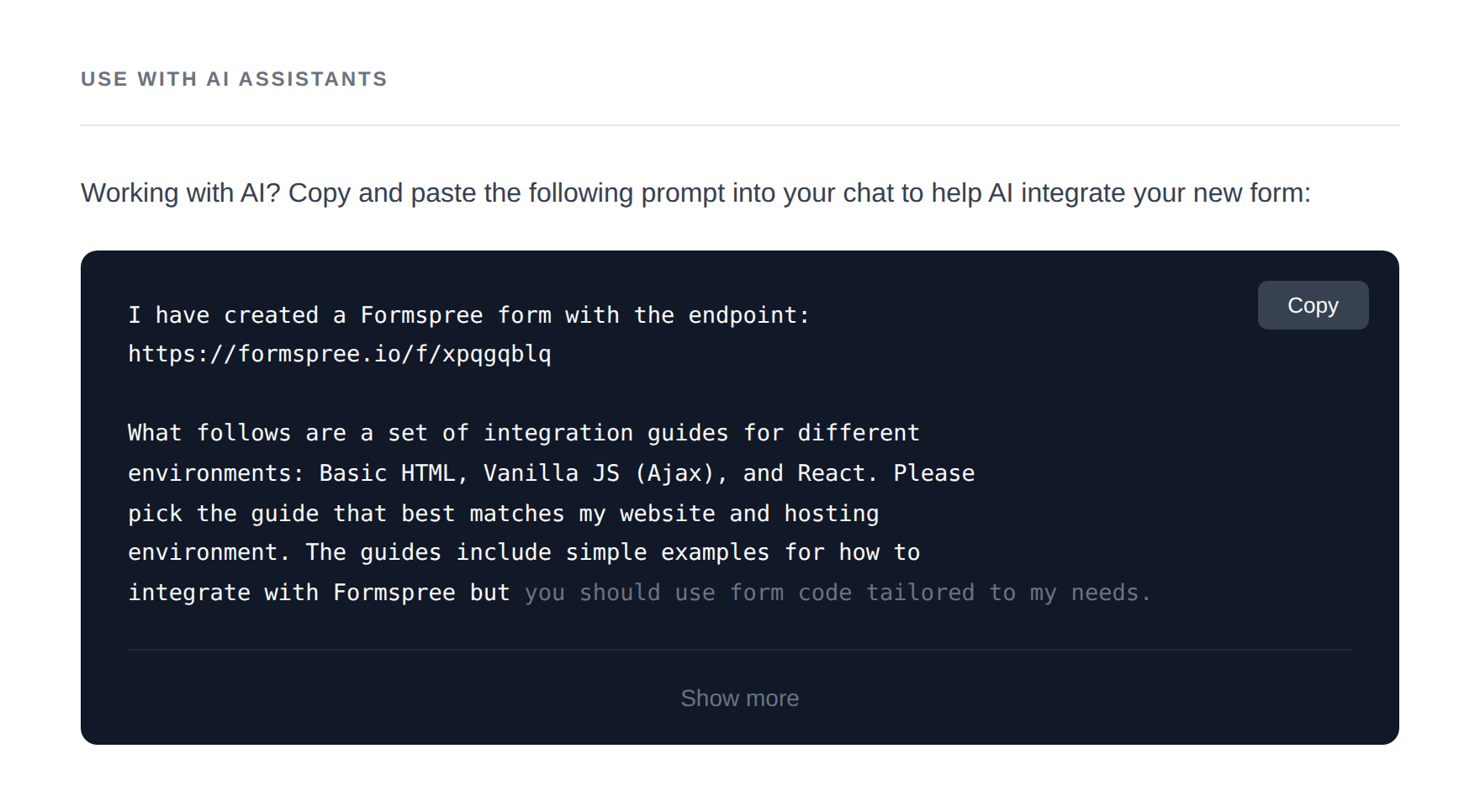
<p>Then do what the best API companies have always done: show, don’t tell. The old gold standard was a docs page with the same call written out in five languages, ready to copy. The next step is documentation an agent can read and run. Here is an example of Formspree doing this well.</p>

<p><img src="/assets/images/agent-first-formspree.png" alt="Formspree's &quot;Use with AI Assistants&quot; panel" /></p>

<p><em>Formspree’s “Use with AI Assistants” panel: one click copies a ready-made prompt, endpoint included, straight into your AI chat, bundled with integration guides for plain HTML, vanilla JS, and React.</em></p>

<p>That is the next step of user-friendly documentation. And it’s worth pointing AI at the specs themselves: enriching, maintaining, and stress-testing them is precisely the kind of work it’s good at.</p>

<h3 id="3-change-feeds-not-polling">3. Change feeds, not polling</h3>

<p>Agents need to react the moment something changes, and polling for that is wasteful, brittle, and expensive, like refreshing your inbox every thirty seconds forever. Give them webhooks and cursor-based change feeds, with the boring guarantees that make them trustworthy: replay, dedupe, idempotency. That’s the difference between an agent that waits and an agent that responds.</p>

<h2 id="a-critique-no-names-the-calendar-problem">A critique, no names: the calendar problem</h2>

<p>Calendars are the cleanest example of UI-first thinking that hasn’t caught up. The moment a calendar makes export partial or lossy, locks event metadata in, or quietly discourages programmatic create-and-edit, it stops being neutral infrastructure and becomes a wall. A calendar isn’t a calendar anymore; it’s a shared coordination database for humans and agents at once, handling scheduling, resource allocation, work routing, and compliance logging. Constrain the integration and you don’t just annoy me, you constrain every use case someone might have built on top of it.</p>

<p>The assistant layer is catching up unevenly. Gemini still feels a step behind here, while Notion AI has genuinely impressed me as a copilot sitting on top of a calendar. That gap is the point: the products that open up are the ones that win the assistant.</p>

<h2 id="you-dont-need-full-orchestration-to-win">You don’t need full orchestration to win</h2>

<p>The agent-first future is already partly here, and you don’t have to build all of it to benefit. Plenty of products already ship genuinely good chatbots, accurate and grounded and useful, so the hardest surface is no longer the blocker. What’s missing is the plumbing between apps. In the instant-attention, one-shot culture we live in, you often don’t need a full integration to bridge that gap. One-click canned options, “copy this as context,” “send this summary over there,” are enough to port the data that actually matters from one app into the next.</p>

<p>Full seamless integration is possible, and orchestration frameworks will get you there. But for the ad hoc case, manual integration isn’t the enemy; a three-click workflow is perfectly acceptable. Especially now that voice-to-text has gotten good. With a tool like WisprFlow I can move synthesized context from one place to another just by saying it, paying far less of the context-switching tax and getting a quick summary of what was carried across.</p>

<p>It all loops back to the first principle. If your data comes out clean, it hardly matters whether the thing moving it is a polished orchestration layer or a tired human with a voice tool and three clicks to spare. Clean data travels both ways.</p>

<h2 id="design-for-the-operator-you-cant-see-yet">Design for the operator you can’t see yet</h2>

<p>The best products of the next decade will be easier for an agent to operate than for a human. Not because humans stop mattering, but because the model underneath is clean and the surfaces are open.</p>

<p>“Just make export easy” sounds like a small ask. It’s really a test of intent. The honest API, the change feed, the clean export all fall out of one decision: to treat your users’ data as theirs, and to let it move. As intelligence gets cheaper by the month, that openness is the moat, and interoperability is what turns a product from a destination into a node in something larger.</p>

<p>So if you’re shipping software today, you’re not just designing screens. You’re signing an ecosystem contract. Make it easy for an agent to cooperate with your product, and you’ll build something that keeps paying you back.</p>

<p>Start with the one click.</p>]]></content><author><name>Abhishek Balakrishnan</name></author><category term="Products" /><category term="AI" /><summary type="html"><![CDATA[The next wave of software is defined by systems an agent can operate, compose, and trust. Three principles every product needs to get there.]]></summary></entry><entry><title type="html">Liftoff.</title><link href="https://solutions.theanbgroup.com/blog/liftoff/" rel="alternate" type="text/html" title="Liftoff." /><published>2026-06-29T00:00:00+00:00</published><updated>2026-06-29T00:00:00+00:00</updated><id>https://solutions.theanbgroup.com/blog/liftoff</id><content type="html" xml:base="https://solutions.theanbgroup.com/blog/liftoff/"><![CDATA[<p>Welcome to <strong>Escape Velocity</strong>.</p>

<p>Every week, I’m going to write about the thing I find most interesting right
now: how great technology actually gets built and gets off the ground.</p>

<p>Some of the sharpest products and ideas I see today are coming from places
people aren’t watching closely — small teams, new tools, and service businesses
quietly shipping remarkable things. I want to pull those into the open, look at
what makes them work, and share what I’ve learned from years in the CTO chair
making similar calls.</p>

<p>Each edition is one practical idea, drawn from one of four threads:</p>

<h2 id="mindset">Mindset</h2>
<p>How the strongest builders think about leverage, speed, and risk — and the
small shifts in judgment that change outcomes.</p>

<h2 id="products--technology">Products &amp; technology</h2>
<p>What’s being built that matters, why it works, and what the rest of us can
borrow from it.</p>

<h2 id="the-optimization-games-worth-playing">The optimization games worth playing</h2>
<p>Where effort actually compounds for a team, and which games deserve your
attention right now.</p>

<h2 id="ai-for-operations">AI for operations</h2>
<p>Where AI is already a clear win for how teams run, and how to put it to work
this quarter — practical, grounded, real.</p>

<h2 id="who-this-is-for">Who this is for</h2>
<p>If you build products, lead a team, or just love watching great technology take
off, you’ll feel at home here. The only prerequisite is curiosity.</p>

<h2 id="the-cadence">The cadence</h2>
<p>One edition a week. Short enough to read with your coffee, useful enough to act
on by the afternoon.</p>

<p>That’s the climb. I’m glad you’re here for it.</p>

<p><strong>One ask to start:</strong> <a href="https://www.linkedin.com/newsletters/escape-velocity-7477519548271955968/">reply or drop a comment on LinkedIn</a> and tell me what you’re building
or where you’re stuck. The best editions will come straight from what you’re
actually wrestling with.</p>

<p>See you next week.</p>

<p>— Abhishek</p>]]></content><author><name>Abhishek Balakrishnan</name></author><category term="Mindset" /><category term="Products" /><category term="AI" /><summary type="html"><![CDATA[The first edition of Escape Velocity — what this newsletter is about, who it's for, and what we'll explore together every week.]]></summary></entry></feed>